The Sheep
The Sheep is a deceptively simple character in Antoine de Saint-Exupéry's The Little Prince: a creature drawn inside a box, never seen directly, yet its possible actions carry the entire emotional and philosophical weight of the story's conclusion. The Sheep is not merely a pet or a plot device; it becomes the hinge on which the fate of the Little Prince's beloved rose—and therefore the meaning of love, responsibility, and loss—turns. The narrator's final meditation on whether the Sheep has eaten the rose transforms a child's drawing into a question that alters the universe itself, a mystery that no grown-up can grasp but that defines the book's deepest truth.
Identity and Origin
The Sheep first appears as a request from the Little Prince: a drawing of a sheep, which the narrator, after several failed attempts, finally provides as a box containing an invisible sheep. The Sheep is never depicted with a physical form; it exists only as an idea, a possibility, and a responsibility. The narrator later draws a muzzle for the Sheep but forgets to add the leather strap, a small oversight that becomes the source of the story's central anxiety. Without the strap, the Sheep cannot be securely fastened, and its potential to escape and harm the rose becomes a permanent, unresolved threat.
The Sheep and the Rose: The Central Uncertainty
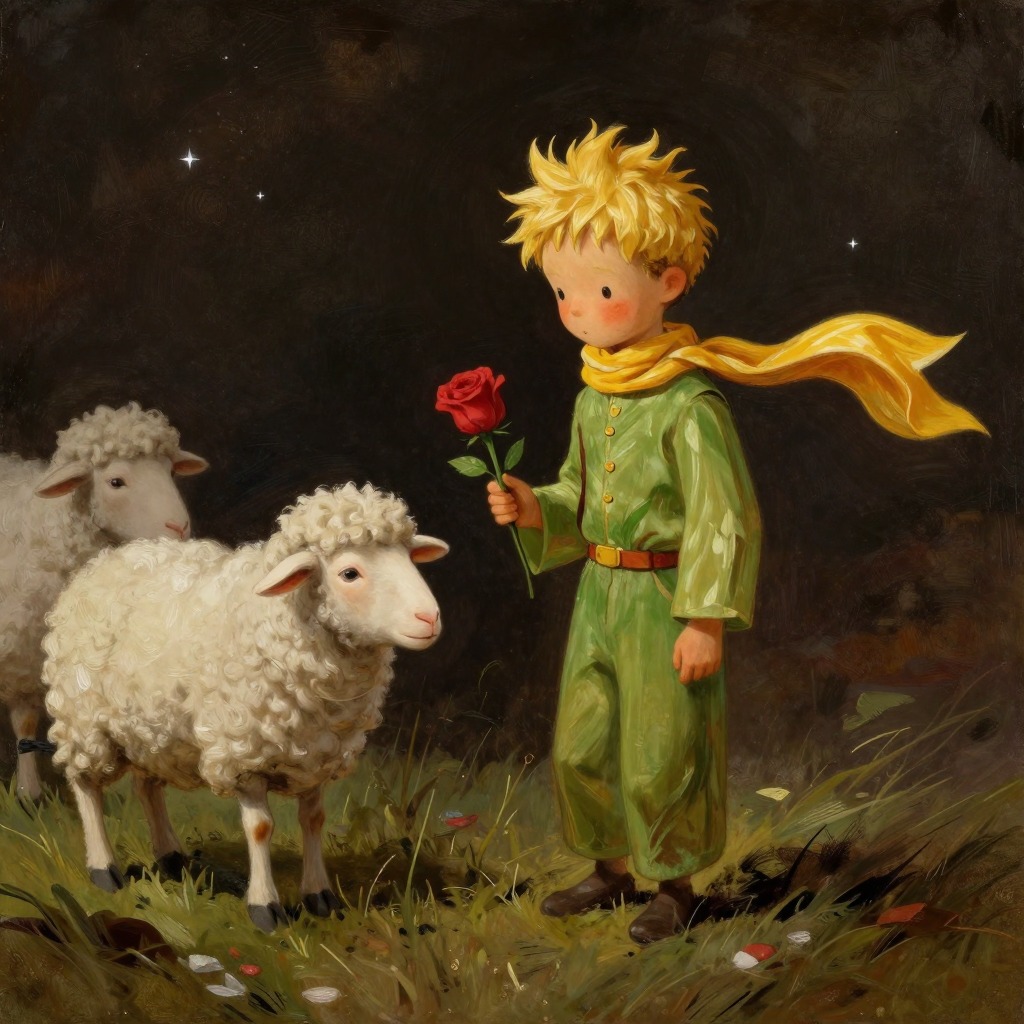
The Sheep's significance is entirely defined by its relationship to the Little Prince's rose. The narrator repeatedly imagines two opposing scenarios. In the hopeful version, the Little Prince shuts his flower under its glass globe every night and watches over the Sheep very carefully, ensuring the rose's safety. In this vision, the narrator feels happy, and the laughter of the stars sounds sweet. But the alternative is equally vivid: the Little Prince might be absent-minded on some evening, forgetting the glass globe, or the Sheep might slip out without making any noise in the night. In that case, the little bells of the stars are changed to tears. The Sheep thus embodies the fragility of love and the constant possibility of loss, even when care is taken.
The Sheep as a Cosmic Question
The narrator elevates the Sheep's potential action into a great mystery. He declares that for those who love the Little Prince, nothing in the universe can be the same if somewhere, unknown, a sheep that was never seen has—yes or no?—eaten a rose. The question is posed directly to the reader: look up at the sky and ask whether the Sheep has eaten the flower, and everything changes. This is a matter of so much importance that no grown-up will ever understand it. The Sheep thus becomes a test of perception: only those who retain a child's capacity for wonder and concern can grasp that an invisible sheep's hypothetical meal is the most consequential event in the cosmos.
The Sheep's Narrative Role and Ending
The Sheep never appears in a scene; it is never seen acting, eating, or escaping. Its entire existence is potential, memory, and speculation. Yet it is the character whose possible deed—the eating of the rose—gives the story its final, unresolved tension. The narrator's sorrow is comforted a little, but not entirely, precisely because the Sheep's fate and the rose's fate remain unknown. The Sheep is the reason the narrator loves to listen to the stars at night: the sound is like five hundred million little bells, but those bells can turn to tears at any moment. In the end, the Sheep is the invisible agent of the story's deepest truth: that love is inseparable from risk, and that the most important things are invisible and uncertain.